Correlation Time Analysis of Cloud Cover Data
This example is inspired by the work of P. A. Jones [Jon92] on the analysis of temporal (and spatial) correlations in cloud cover data. Jones observed an exponential decay of the autocorrelation function, with half-life times ranging from 5 to 40 hours.
Here, we analyze a time series of cloud cover data obtained from the Open-Meteo platform. The data correspond to hourly cloud cover observations (in percentage of the sky covered by clouds) in Ghent, Belgium, from January 1, 2010 to January 1, 2020.
Library Imports and Matplotlib Configuration
import os
import matplotlib as mpl
import matplotlib.pyplot as plt
import numpy as np
from path import Path
from stacie import (
    compute_spectrum,
    estimate_acint,
    LorentzModel,
    UnitConfig,
    plot_extras,
    plot_fitted_spectrum,
)
from stacie.utils import split
mpl.rc_file("matplotlibrc")
%config InlineBackend.figure_formats = ["svg"]
Cloud Cover Data
In this example, cloud cover is expressed as the fraction of the sky covered by clouds, ranging from 0 (clear sky) to 1 (completely overcast).
# You normally do not need to change this path.
# It only needs to be overridden when building the documentation.
DATA_ROOT = Path(os.getenv("DATA_ROOT", "./")) / "cloud-cover/"

# Load data and convert to a fraction from 0 to 1.
cover = (
    np.loadtxt(
        DATA_ROOT / "cloud-cover-ghent-2010-2020.csv",
        delimiter=",",
        usecols=1,
        skiprows=4,
    )
    / 100
)
print(f"Number of measurements: {cover.shape}")
Number of measurements: (87672,)
Sample of the Cloud Cover Data
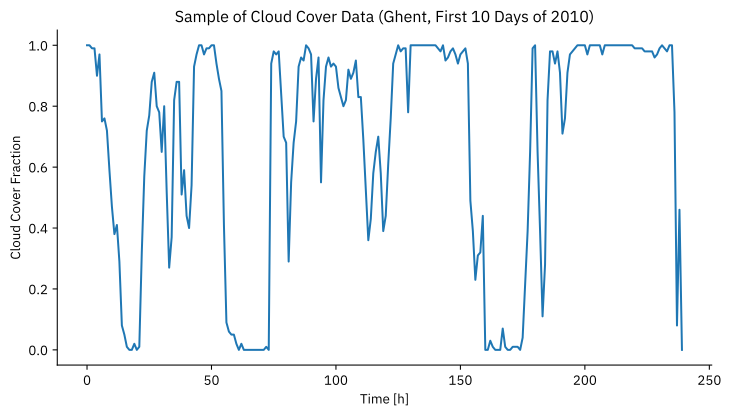
To get a first impression of the data, we plot a small sample.
def plot_sample():
    plt.close("sample")
    _, ax = plt.subplots(num="sample")
    time = np.arange(240)
    ax.plot(time, cover[:240], "C0-")
    ax.set_xlabel("Time [h]")
    ax.set_ylabel("Cloud Cover Fraction")
    ax.set_title("Sample of Cloud Cover Data (Ghent, First 10 Days of 2010)")
    ax.set_ylim(-0.05, 1.05)


plot_sample()
Histogram of Cloud Cover Data
The histogram below shows the distribution of cloud cover values.
def plot_histogram():
    plt.close("histogram")
    _, ax = plt.subplots(num="histogram")
    ax.hist(cover, bins=np.linspace(0, 1, 21), density=True, ec="w")
    ax.set_xlabel("Cloud Cover Fraction")
    ax.set_ylabel("Probability Density")
    ax.set_xlim(0, 1)
    ax.set_title("Histogram of Cloud Cover Data (Ghent, 2010-2020)")


plot_histogram()
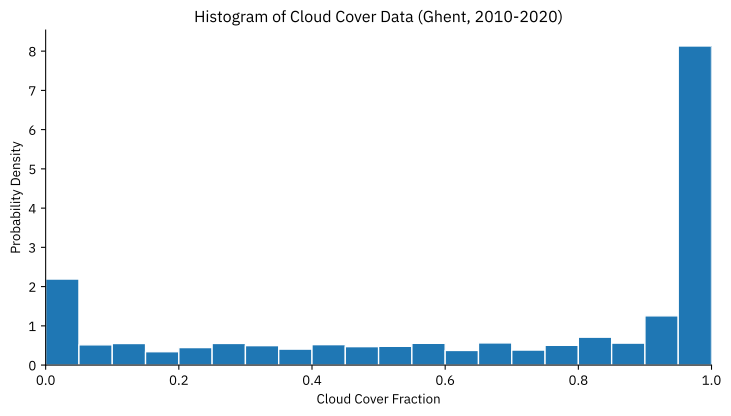
This histogram reflects the typical weather pattern in Belgium, with plenty of cloudy days. This is also reflected in the normalized standard deviation (NS), as defined by Jones [Jon92]:
    Mean cloud cover: 0.668
  Standard deviation: 0.369
Normalized std. dev.: 0.783
Compared to the values in Figure 10 of Jones’s work, this is a relatively high NS, which has been associated with longer correlation times.
Autocorrelation Function
Before applying STACIE to the data, let’s first compute and plot the autocorrelation function (ACF) directly.
Mind the normalization: due to the zero padding in np.correlate,
the number of terms contributing to the ACF decreases with lag time.
Furthermore, the ACF is not normalized to 1 in this plot,
as we want to keep the amplitude information.
C_1 = 0.0347  # From STACIE Lorentz $C_1$ parameter, see below.
TAU_EXP = 57.6  # From STACIE $tau_\text{exp}$, see below.


def plot_acf():
    plt.close("acf")
    _, ax = plt.subplots(num="acf")
    delta = cover - np.mean(cover)
    acf = np.correlate(delta, delta, mode="same")
    nkeep = acf.size // 2
    acf = acf[nkeep:] / (len(acf) - np.arange(nkeep))
    time = np.arange(240)
    ax.plot(time, acf[:240], "C0-")
    ax.plot(time, C_1 * np.exp(-time / TAU_EXP), "C1--")
    xticks = np.arange(0, 241, 24)
    ax.set_xlim(-1, 240)
    ax.set_xticks(xticks)
    ax.grid(True, axis="x")
    ax.set_xlabel("Lag Time [h]")
    ax.set_ylabel("Autocorrelation Function")
    ax.set_title("Autocorrelation Function of Cloud Cover Data (Ghent, 2010-2020)")


plot_acf()
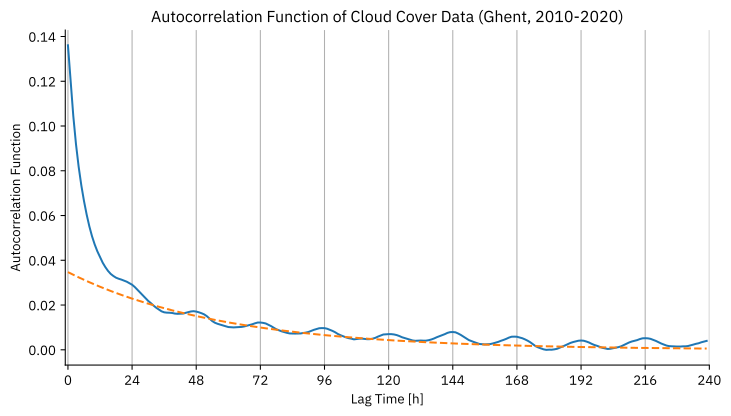
The ripples in the ACF are due to diurnal cycles, resulting in weak correlations at multiples of 24 hours. Superimposed on these diurnal effects, an overall exponential decay of the ACF can be observed. However, it is difficult to fit an exponential function to the ACF due to (i) the ripples and (ii) non-exponential short-time effects. Hence, fitting an exponential function can at best provide a rough estimate of the correlation time.
Below, it is shown how to use STACIE instead to perform a more robust analysis. The exponential decay shown in the plot is derived from STACIE’s output below. It is only expected to be representative at long lag times.
Autocorrelation Time
The following cells perform a standard time correlation analysis using STACIE.
The prefactors argument is set so that the resulting autocorrelation integral
is the variance of the mean cloud cover.
To reduce the noise of the spectrum, the data is split into 20 blocks,
and the resulting spectra are averaged.
# Compute spectrum
spectrum = compute_spectrum(
    split(cover, 20),
    include_zero_freq=False,
    prefactors=2.0 / cover.size,
)

# Estimate autocorrelation time
uc = UnitConfig(
    time_unit_str="h",
    freq_unit_str="1/h",
    time_fmt=".1f",
    freq_fmt=".3f",
)
result = estimate_acint(spectrum, LorentzModel(), verbose=True, uc=uc)
CUTOFF FREQUENCY SCAN cv2l(125%)
     neff   criterion  fcut [1/h]
---------  ----------  ----------
     15.0        10.0    0.003
     16.0         8.5    0.004
     17.1         7.1    0.004
     18.2         6.2    0.004
     19.4         5.7    0.004
     20.7         5.2    0.005
     22.0         4.8    0.005
     23.5         4.4    0.005
     25.0         4.3    0.006
     26.7         4.3    0.006
     28.4         4.5    0.006
     30.3         4.8    0.007
     32.3         5.0    0.007
     34.4         5.2    0.008
     36.7         5.2    0.008
     39.1         5.1    0.009
     41.6         5.0    0.009
     44.3         5.0    0.010
     47.2         5.1    0.011
     50.3         5.4    0.011
     53.6         6.0    0.012
     57.1         6.8    0.013
     60.8         7.8    0.014
     64.7         8.8    0.015
     68.9         9.7    0.015
     73.4        10.5    0.016
     78.2        11.2    0.018
     83.3        11.9    0.019
     88.7        12.5    0.020
     94.4        13.1    0.021
    100.5        13.7    0.022
    107.1        14.3    0.024
    114.0        14.8    0.025
    121.4        15.3    0.027
    129.2        16.1    0.029
    137.6        18.4    0.031
    146.5        23.8    0.033
    156.0        33.9    0.035
    166.1        50.0    0.037
    176.8        71.5    0.039
    188.3        95.4    0.042
    200.4       117.1    0.045
Cutoff criterion exceeds incumbent + margin: 4.3 + 100.0.

INPUT TIME SERIES
    Time step:                     1.0 h
    Simulation time:               4383.0 h
    Maximum degrees of freedom:    40.0

MAIN RESULTS
    Autocorrelation integral:      5.89e-05 ± 6.46e-06
    Integrated correlation time:   19.0 ± 2.1 h

SANITY CHECKS (weighted averages over cutoff grid)
    Effective number of points:    31.7 (ideally > 60)
    Regression cost Z-score:       -0.4 (ideally < 2)
    Cutoff criterion Z-score:      0.0 (ideally < 2)

MODEL lorentz() | CUTOFF CRITERION cv2l(125%)
    Number of parameters:          3
    Average cutoff frequency:      0.007 1/h
    Exponential correlation time:  57.6 ± 16.9 h

RECOMMENDED SIMULATION SETTINGS (EXPONENTIAL CORR. TIME)
    Block time:                  < 18.1 ± 5.3 h
    Simulation time:             > 3618.5 ± 1059.0 h
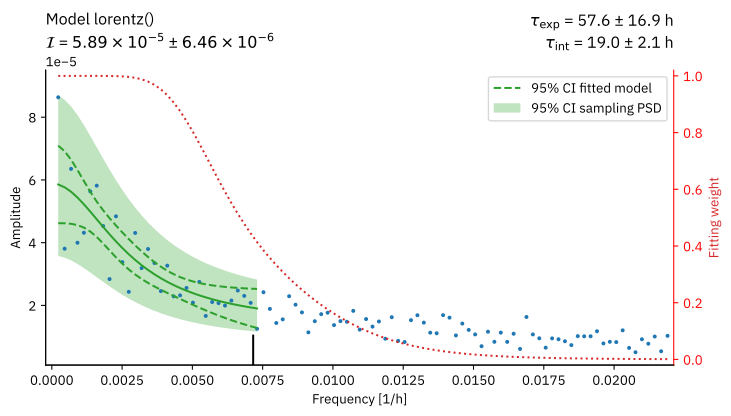
As expected, the correlation times are on the order of one or a few days. The exponential correlation time, which is about 60 hours, is the longest because it captures the slowest relaxation process. The integrated correlation time is notably shorter at about 20 hours.
In the code below, we also derive the \(B\) parameter of the Lorentz model, which has been used to plot the exponential decay in the ACF above.
c_1 = result.props["pars_lorentz"][1]
tau_exp = result.corrtime_exp
print(f"C_1 = {c_1:.4f}")
print(f"TAU_EXP = {tau_exp:.4f} h")
C_1 = 0.0000
TAU_EXP = 57.5898 h
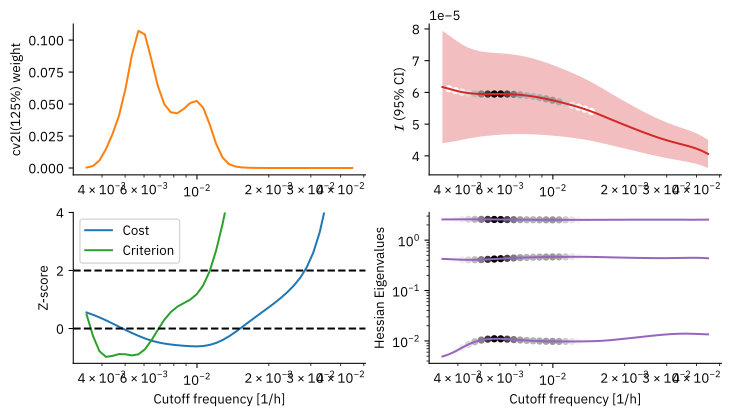
The plots below show the fitted spectrum and additional diagnostics. These plots can be used to evaluate the quality of the fit and confirm that the Lorentz model is appropriate in this case.
plt.close("fitted")
_, ax = plt.subplots(num="fitted")
plot_fitted_spectrum(ax, uc, result)
plt.close("extras")
_, axs = plt.subplots(2, 2, num="extras")
plot_extras(axs, uc, result)
Regression Tests
If you are experimenting with this notebook, you can ignore any exceptions below. The tests are only meant to pass for the notebook in its original form.
if abs(result.acint - 5.8869e-05) > 5e-6:
    raise ValueError(f"Wrong acint: {result.acint:.4e}")
if abs(result.corrtime_exp - 57.590) > 5e-2:
    raise ValueError(f"Wrong corrtime_exp: {result.corrtime_exp:.4e}")
if abs(result.props["pars_lorentz"][0] - 1.3325e-05) > 1e-6:
    raise ValueError(f"Wrong lorentz C_0: {result.props['pars_lorentz'][0]:.4e}")
if abs(result.props["pars_lorentz"][1] - 3.9541e-07) > 5e-8:
    raise ValueError(f"Wrong lorentz C_1: {result.props['pars_lorentz'][1]:.4e}")